
Sunday Supper Table: my full letter by email, every Sunday.
Each letter takes one piece of old-time cooking, from the chuck wagon's Dutch oven to the Sunday table, shows it step by step in large type, and tells you why it works. When a dish is cooked over coals, the letter also tells you how to bake it in your kitchen oven.
This page only explains it. You don't pay anything here.
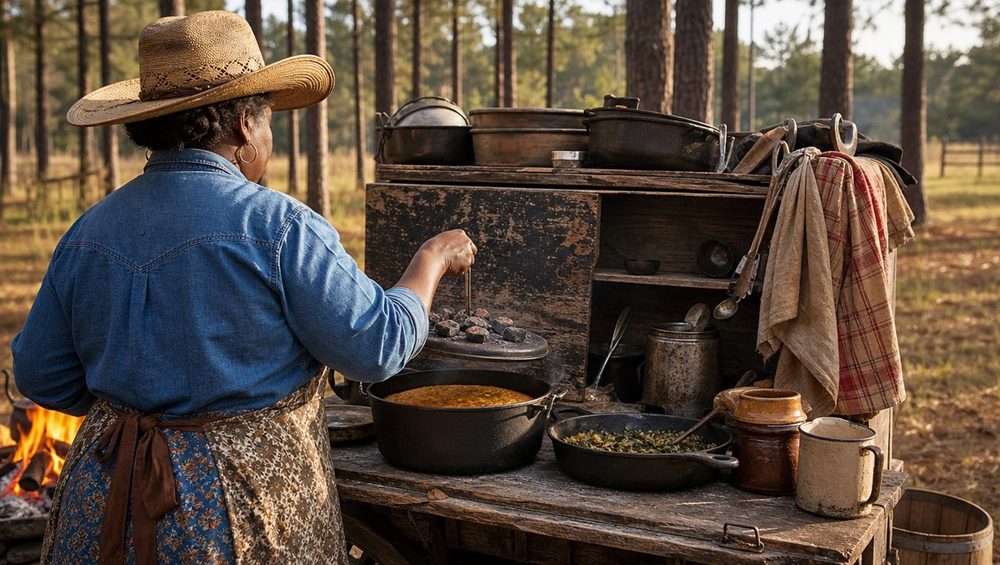
What lands in your inbox every Sunday
One old way of cooking, and the why behind it
Letter 1: why the lid of a Dutch oven carries two-thirds of the coals, and an 1881 corn egg bread baked under it.
Old recipes, read line by line
This month: Abby Fisher's corn egg bread and sweet potato pie from 1881, her measures turned into today's cups, and a plain note wherever she gave no amount.
Tables you can cook from
This month: a coal chart for 8- to 14-inch Dutch ovens, cornbread dressing for 4 to 16, a pie scaler for 1 to 6 pies, and old oven words in degrees.
A page to print
This month, every letter shown here comes with a printable PDF.
Every letter already sent
The day you join, the earlier letters are yours to read, any time.
A reply that gets read
Hit reply on any letter. Our team reads every one. With your permission, readers' stories may run in Pass the Plate.
Every letter lists its sources at the end, so you can check them yourself.
Read the start of a real letter
This is Letter 1, dated November 1, 2026. Nothing here is made up for this page.
Sunday Supper Table · Letter 1 · November 1, 2026
Coals on the lid: the two-thirds rule
The bottom of a Dutch oven burns first. Always. So the lid has to carry most of the fire.
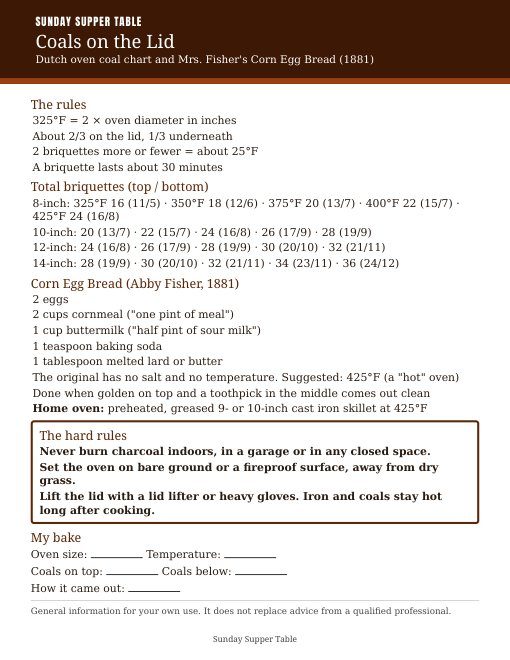
Pull up a chair. Here is the whole rule in one breath, from the Missouri Department of Conservation: double your oven's width in inches, and that is how many briquettes give you about 325°F. Put two-thirds on the lid and one-third underneath.
A 10-inch oven takes 20 briquettes: 13 on top, 7 below. A 12-inch oven takes 24.
Today we put that rule to work on a cornbread written down in 1881. Bake it this month, let it dry out, and it will be the start of your holiday dressing.
Why the lid gets more
Here's the thing. Heat rises. Coals under the pot push their heat straight into the bottom, right where the batter sits on the iron. Coals on the lid send heat down through the air inside the pot, which is gentler.
So you load the top to bake the bread through and brown the crust, and you keep the bottom light so it doesn't scorch. That is general cooking sense, and it's why the old cooks put fire on the lid at all.
The coal chart
Each 25°F above 325°F adds 2 briquettes. Top and bottom are rounded to the nearest whole coal.
Lid Down Supper: Mrs. Fisher's Corn Egg Bread
This is recipe No. 8 in *What Mrs. Fisher Knows About Old Southern Cooking*, printed in San Francisco in 1881. Here are her measures as written, and what they come to in today's cups.
Now, I'll say it plainly: her recipe lists no salt and no oven temperature. Salt it to your own taste if you like. For heat, the old cookbooks called 400 to 450°F a "hot" oven, so I'd pick 425°F. That's my choice, not hers.
- Light your briquettes. For a 10-inch oven at 425°F, that's 28: 19 for the lid, 9 for underneath.
- Grease the inside of the oven well with lard or butter.
…and the letter goes on:
- Why the lid gets more coals than the bottom
- A coal chart for 8-, 10-, 12- and 14-inch ovens, from 325°F to 425°F
- Mrs. Fisher's 1881 measures next to today's cups
- Seven steps to bake it under the lid, and the quarter turn that keeps hot spots moving
- How to bake it in a cast iron skillet in your kitchen oven
- The woman behind the recipe: Abby Fisher's story
- A page to print, and the sources listed at the end
Or keep reading: the month's letters, how the free week works and how to cancel are just below.
November's letters
- Nov. 1Coals on the lid: the two-thirds ruleHow many coals go on top, how many below, and a cornbread to bake with them.
- Nov. 22Mama never wrote it down. Here's how.A real recipe with measurements, the wet sand test, and a plan for this week.
- Nov. 29One gill of milk? Let's read the old cardA gill, 'bake quickly,' no sugar amount. What each one means today.
This November the letters lead up to Thanksgiving and past it: coals on a Dutch oven lid, bringing a rusty pot back to the table, cornbread dressing when Mama never wrote it down, and an 1881 sweet potato pie. The list shows this month's letters.
The free note or the full letter?
| The free note | Sunday Supper Table | |
|---|---|---|
| What arrives each Sunday | A short email: the first lines of that week's letter | The whole letter, start to finish |
| The step-by-step | No. The note stops where the steps begin | Yes, every step |
| Pages to print | Not part of the weekly note | Yes, when the letter has one |
| Earlier letters | No | Yes, all of them |
| Payment needed | No | Yes |
| Price | $0 | 7 days free, then $14.99 a month |
| To stop | One click | Cancel anytime from the link in every letter |
The free note
- What arrives each Sunday
- A short email: the first lines of that week's letter
- The step-by-step
- No. The note stops where the steps begin
- Pages to print
- Not part of the weekly note
- Earlier letters
- No
- Payment needed
- No
- Price
- $0
- To stop
- One click
Sunday Supper Table
- What arrives each Sunday
- The whole letter, start to finish
- The step-by-step
- Yes, every step
- Pages to print
- Yes, when the letter has one
- Earlier letters
- Yes, all of them
- Payment needed
- Yes
- Price
- 7 days free, then $14.99 a month
- To stop
- Cancel anytime from the link in every letter
How the 7 free days work
You join. Nothing is charged. A welcome email brings you the letters already out, so you can start reading.
We email you a reminder with the date your free week ends, the amount, and the link to cancel.
One more short reminder: your free week ends tomorrow.
If you stay, $14.99 is charged, and then once a month. If you canceled, you pay nothing.
And every Sunday, the new letter.
How to cancel
At the bottom of every letter there is a link that says “Manage or cancel membership”. It opens your membership page, and from there you cancel on Hotmart, the company that handles the payment. It takes a couple of clicks.
No phone call. Nothing to mail. Cancel during the 7 free days and you pay nothing.
Stuck? Write to omar@mbonf.com and our team will help.
Try Sunday Supper Table free for 7 days
$0 today. Then $14.99 a month.
Cancel anytime. The payment page shows the exact amount before you confirm.
What happens when you press the button
- A secure payment page opens. It is run by Hotmart, the company that handles our payments. At the top you will see “Sunday Supper Table” and the monthly price.
- It asks for your email, your name, and how you want to pay.
- The page shows your 7 free days and the amount charged after them. Check it before you go on.
- Press the green button at the bottom of that page. Nothing is charged for the first 7 days.
- Your welcome email follows, with the letters already out.
$14.99 a month after your 7 free days, unless you cancel first.
Fair questions
Who writes the letters?
Sharon Lockett is the character of this channel. The letters are written by our team with AI assistance, and the facts are checked against the sources listed at the end of each letter. Replies are read by our team.
Is it the same as the books?
No. The books are a one-time purchase and they stay yours. The letters are new every week, and you don't need the books to follow them.
What are the letters about?
This November the letters lead up to Thanksgiving and past it: coals on a Dutch oven lid, bringing a rusty pot back to the table, cornbread dressing when Mama never wrote it down, and an 1881 sweet potato pie. The list shows this month's letters.
Will I be charged today?
No. Your first 7 days are free. $14.99 is charged when they end, and then once a month, unless you cancel first.
Not ready? Take the free Sunday note instead.
A short email each Sunday: the first lines of that week's letter. No card. One click stops it.
Free. One click to stop. Your address is used for this and nothing else.